
“Trust But Verify” The Real Origin, Meaning & How to Apply It
If you’ve heard “trust but verify” used in a business meeting, a leadership book, or a documentary, and assumed it was a modern management phrase or something Ronald Reagan personally coined, you’re not alone but the real story is older, and more interesting, than that. This page covers where the phrase actually comes from, what it really means, and how to use it in real relationships, work, and faith, without the historical shortcuts most quote sites take.
This is one of those rare quotes where the actual documented history is genuinely well established, not just widely repeated which makes it worth getting right rather than settling for the shorthand version most people have heard. If you’re here because you need this for a paper, speech, or presentation that requires accuracy, this page should give you what you need. If you’re here because the phrase resonates with something you’re navigating personally, there’s a section further down specifically on that.
The Quote (and the Common Misconception About It)
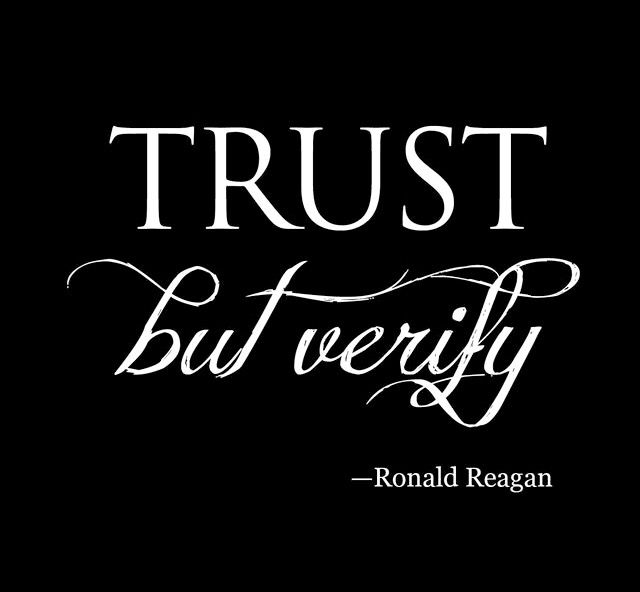
The phrase, as most people know it, is simply: “Trust, but verify.” It’s short, memorable, and slightly uncomfortable which is probably why it’s stuck around for decades. Most people who’ve heard it assume it’s an American political phrase, something a president said in a speech and it caught on from there. That assumption is understandable, but it isn’t accurate, and getting the history right actually makes the phrase more interesting, not less.
Where “Trust But Verify” Actually Comes From
The phrase is a Russian proverb doveryai, no proveryai which rhymes in the original Russian, and which loosely translates to the idea that a responsible person verifies things even when dealing with someone they trust. It wasn’t invented in the West at all. Ronald Reagan didn’t come up with it; he learned it. During preparation for nuclear disarmament talks with Soviet leader Mikhail Gorbachev, Reagan’s advisor on Russian affairs, Suzanne Massie, suggested he learn a few Russian proverbs, reasoning that Russians tend to enjoy speaking that way and that Reagan, as a former actor, would pick a few up quickly. Out of everything she offered him, “trust but verify” became the one he liked most and then used constantly.
Interestingly, the exact origin of the Russian proverb itself is murky even to Russian historians. It doesn’t appear in one of the most comprehensive 19th century collections of Russian proverbs, which suggests the phrase, in this exact form, likely emerged sometime around the very end of the 1800s or early 1900s rather than being an ancient saying. Versions of the same underlying idea verify, don’t just take someone’s word for it were also voiced by other Russian political figures earlier in the 20th century, including a version attributed to Vladimir Lenin in a 1914 speech, phrased less elegantly but carrying the same core sentiment.
So the accurate, honest version of the story is this: a centuries-old-sounding but likely early 20th century Russian proverb was taught to an American president by his advisor, and he made it internationally famous by repeating it constantly in a completely different context than the one it originally came from.
Why the Russian Origin Matters More Than People Realize
It’s worth pausing on why the proverb’s original Russian usage is a little different in tone than how Americans tend to use it today. In its original context, the phrase carries an undertone of healthy, almost expected suspicion the assumption in Russian culture, according to several historical accounts, leans more toward “verify because trust alone usually isn’t sufficient,” rather than the softer American reading of “trust first, and verification is just a formality.” Some later Soviet leaders, including reported phrasings from Lenin and Stalin, leaned even further into the distrust side of the saying, treating verification as the default rather than trust. Reagan’s use of the phrase, by contrast, generally leaned toward the more optimistic, trust forward interpretation he tended to present it as a friendly, almost diplomatic gesture rather than a statement of suspicion, which may be part of why Gorbachev found his repeated use of it a little tiresome; the two men may have been hearing slightly different implications in the same six words.
How Reagan Made It Famous
Once Reagan adopted the phrase, he used it repeatedly and publicly, especially in the context of nuclear arms negotiations with the Soviet Union. It became something close to his signature line on the subject. At the signing of the INF Treaty in December 1987, a major nuclear disarmament agreement between the US and USSR Gorbachev, visibly tired of hearing it, remarked to Reagan, “You repeat that at every meeting,” to which Reagan simply replied, “I like it.” That small exchange has become almost as well-known as the phrase itself, partly because it captures something true about Reagan’s personality and partly because it’s a genuinely funny moment between two leaders who otherwise represented opposing superpowers.

The phrase reached an even wider modern audience decades later through HBO’s Chernobyl miniseries, in which a Soviet KGB character uses the phrase and then mocks the idea that Americans think Reagan invented it a small but pointed nod to the real history behind the line.
Is “Trust But Verify” a Contradiction?
This is a genuinely common debate, and it’s worth addressing directly rather than glossing over it. Some people argue the phrase is an oxymoron if you have to verify something, doesn’t that mean you don’t actually trust it? Others argue the opposite: that verification isn’t the opposite of trust, but a responsible extension of it, especially in high-stakes situations where the cost of being wrong is significant.
A more useful way to think about it might be this: trust is a starting posture, not a final conclusion. You can extend goodwill and good faith toward someone assuming positive intent while still checking the details, because checking isn’t the same as assuming bad faith. In fact, in some relationships, verification done respectfully can actually build trust over time, since it creates a track record rather than relying purely on assumption.
What This Quote Means Today
Outside of its original geopolitical context, “trust but verify” has become a general-purpose principle applied to almost any relationship involving risk — business partnerships, hiring, cybersecurity, parenting, even personal relationships. The core idea stays the same across all of them: extending trust doesn’t mean abandoning discernment, and checking on something doesn’t have to mean you’ve stopped trusting the person.
It’s worth noting that the phrase works best as a starting framework, not a rigid rule applied identically to every situation. The amount of “verify” appropriate for a new business vendor is very different from the amount appropriate in a long, established marriage context changes how the principle should actually be applied.
Applying “Trust But Verify” in Relationships
In personal relationships, this phrase gets a bit more emotionally complicated than in business, because verification can feel like suspicion if it’s not handled carefully. A few situations where it applies in a healthy way:
Rebuilding trust after it’s been broken, where some level of verification for a period of time is a reasonable, not punitive, part of repair
New relationships, where getting to know someone’s consistency over time (whether their actions match their words) is simply healthy discernment, not distrust
Situations involving shared finances, where checking in on shared accounts or decisions is practical stewardship, not a lack of faith in the other person
The line becomes unhealthy when verification is constant, disproportionate to any actual reason for concern, or used to control rather than to genuinely confirm safety and consistency. Healthy “trust but verify” fades over time as trust is repeatedly confirmed; unhealthy versions never fade, regardless of how much evidence accumulates.
Applying “Trust But Verify” in Leadership and Work
In a workplace context, this phrase is often used to describe good delegation giving someone real responsibility and trusting them to handle it, while still having reasonable check-ins, reporting structures, or review processes in place. Good leaders tend to use “verify” as a way of catching problems early and supporting their team, not as a way of implying they don’t trust their people. The tone matters enormously here: verification framed as partnership tends to build trust, while verification framed as suspicion tends to erode it, even when the actual process is identical.
This is also part of why the phrase is so heavily used in cybersecurity, where “trust but verify” has evolved into formal frameworks like continuous verification and zero-trust architecture approaches built around the idea that even trusted systems and users should be continuously confirmed, not assumed safe indefinitely.
Trust But Verify in Cybersecurity, Specifically
The cybersecurity world has arguably taken this phrase further than any other industry, evolving it into an entire security philosophy. Traditional security models often assumed that anything already inside a trusted network was safe by default; “trust but verify,” and later the more aggressive “zero trust” model that grew from similar thinking, both reject that assumption. Instead, every user, device, and connection is checked continuously, regardless of whether it’s already inside a supposedly trusted system. It’s a good real-world example of the phrase evolving with the times: the original diplomatic version assumed a baseline of trust with occasional verification, while the modern cybersecurity descendant assumes almost nothing by default and verifies constantly a sign of how much the underlying tension between trust and verification shifts depending on the actual stakes involved.
Trust But Verify in Parenting
Parents often apply a version of this principle as children grow older and start asking for more independence. A parent might extend a new privilege a later curfew, an unsupervised outing, access to a phone while still checking in periodically to confirm that trust is being handled responsibly. Done well, this looks like gradually loosening the “verify” part as a child demonstrates consistency, which teaches the child that trust is something that expands in response to good judgment. Done poorly, verification never fades regardless of how much responsibility a child shows, which can end up teaching the opposite lesson that trust is never actually available to them, no matter what they do.
Common Phrases People Confuse With This One
A few similar-sounding sayings sometimes get blended with “trust but verify” in casual conversation, worth distinguishing:
“Trust, but confirm” a looser paraphrase some people use, carrying largely the same meaning but not the actual historical phrase.
“Don’t trust, verify” a harder-edged variation that removes the trust component entirely, changing the meaning significantly toward pure skepticism.
“Trust everyone but cut the cards” an older English-language gambling expression with a similar spirit, but a separate origin from the Russian proverb.
These aren’t the same saying, even though they circle similar territory, so it’s worth being precise about which one you’re actually referencing if accuracy matters.
How to Know When You’re Over Verifying
Because this phrase gets used to justify a wide range of behavior, it’s worth having a rough gut check for when “verify” has tipped into something less healthy:
You’re verifying the same thing repeatedly even after it’s been confirmed multiple times
The verification is driven more by your own anxiety than by any actual new reason for concern
The person being checked on has consistently met expectations, but the checking hasn’t decreased at all
You’d feel uncomfortable if the other person could see exactly how much you were verifying
None of this mean verification itself is wrong they’re just useful markers for noticing when “trust but verify” has quietly become “verify, and trust is just the word I use to describe it.”
A Faith Based Take on Trust and Discernment
Many people of faith find a version of this same principle already present in scripture trust in God is meant to be complete, but discernment toward people, teachings, and circumstances is still consistently encouraged.
[VERIFY VERSE] a verse commonly associated with testing or examining things carefully is often linked to 1 Thessalonians 5:21, but please confirm the exact wording and translation before quoting or teaching from it.

The distinction scripture tends to draw isn’t between trusting and not trusting it’s between where ultimate trust is placed and how carefully everything else is examined. Complete trust is reserved for God; wise discernment is still expected everywhere else, including in relationships, teachings, and decisions. In that sense, “trust but verify” isn’t in tension with faith it’s arguably a very old, very human echo of a much older principle.
It’s worth noting the difference in direction here, though. The secular version of “trust but verify” is mostly aimed outward how much to trust other people or institutions. The faith-based framing adds a layer of trust that isn’t meant to be verified at all: trust in God’s character isn’t treated as something to be tested the same way a business deal or new acquaintance would be. The “verify” instinct is meant to be applied to the world around us, not to the foundation of faith itself which is an important distinction if you’re applying both ideas at once.
A Short Prayer for Discernment
God, give me a heart that trusts freely, and a mind that stays awake and discerning. Help me tell the difference between healthy caution and fear, and give me the wisdom to know when to simply trust, and when to look more closely. Amen.
A Short Journaling Prompt for This Quote
If this phrase is resonating with you personally right now, try writing a short answer to this: Where in my life am I extending trust without any real discernment, and where might I be verifying out of fear rather than genuine concern? Naming both sides honestly tends to reveal more than just reading the quote and nodding along.
Similar Quotes About Trust and Discernment
“Trust is given freely. Confidence is earned repeatedly.”
“Good faith and good judgment were never meant to cancel each other out.”
“Trust the person. Still read the fine print.”
“Discernment isn’t the opposite of trust it’s what makes trust sustainable.”
“Open hands, open eyes.”
“Believe the best. Still pay attention.”
“Faith in a person and awareness of a person were never meant to cancel each other out.”
A Word on Using This Quote in a Speech, Paper, or Presentation

If you’re planning to cite this quote formally, it’s worth being specific rather than simply attributing it to Reagan. The more accurate framing is that it’s a Russian proverb Reagan learned and popularized internationally not a phrase he originated. That distinction is a small thing, but getting it right adds real credibility if you’re using the quote in any context where accuracy matters, and it also makes for a more interesting point if you’re speaking about it live, since most audiences don’t know the real backstory.
A Reflection on Trust That’s Been Broken
If you searched this quote because trust has actually been broken in one of your relationships, it’s worth naming that honestly rather than jumping straight to a framework. “Trust but verify” can be a useful, practical bridge back toward trust after a breach, but it isn’t a replacement for the harder, slower emotional work of actually rebuilding it. Verification can create the conditions for trust to grow back over time, but it can’t manufacture trust on its own that part still requires consistency, honesty, and time, which no quote can shortcut.
FAQ
Who really said “trust but verify”?
It’s a Russian proverb doveryai, no proveryai that Ronald Reagan learned from his advisor Suzanne Massie and later made famous internationally through his use of it in nuclear disarmament talks with the Soviet Union.
Did Ronald Reagan come up with “trust but verify”?
No — he popularized it, but he didn’t originate it. It was a pre-existing Russian proverb he was taught in preparation for talks with Gorbachev.
What does “trust but verify” mean?
It means extending good faith toward someone or something while still confirming details, especially in situations where the stakes of being wrong are high. It’s meant to balance openness with responsible caution, not to replace trust with suspicion.
Is “trust but verify” a contradiction?
Not necessarily many see verification as a responsible extension of trust rather than its opposite, especially in high-stakes situations. It becomes contradictory mainly when verification is used to control rather than to genuinely confirm safety or consistency.
How can I apply “trust but verify” in a relationship?
It works best applied gently and temporarily for example, during a season of rebuilding trust after a breach rather than as a permanent, ongoing posture in a healthy relationship.
Is there a Bible verse similar to “trust but verify”?
Yes, verses about testing or examining things carefully are often referenced here, though you should confirm the exact wording and reference with a trusted translation before quoting it.
Why did Gorbachev get annoyed at Reagan for this phrase?
Because Reagan used it so frequently in their negotiations that Gorbachev eventually pointed it out directly, saying Reagan repeated it at every meeting to which Reagan simply said he liked it.
Is “trust but verify” only useful in politics or business?
No, while it originated in a diplomatic context, the same principle applies naturally to relationships, parenting, leadership, and even personal faith and discernment.
Where does the phrase show up in pop culture?
It became widely recognized again after being featured in HBO’s Chernobyl, where a character uses the phrase and pointedly notes that Americans mistakenly think Reagan invented it.
Is verifying someone always a sign of distrust?
Not necessarily reasonable verification, done respectfully and proportionate to the actual situation, is often a normal part of responsible relationships and decision-making rather than evidence of suspicion.
What’s the difference between “trust but verify” and “zero trust”?
“Trust but verify” generally assumes a baseline of good faith with occasional checks, while “zero trust,” a later concept mostly used in cybersecurity, assumes far less by default and verifies continuously, regardless of prior trust.
Is “trust but verify” a healthy approach in a marriage?
It can be, in limited, specific circumstances like rebuilding trust after a breach, but as a constant, ongoing posture in an otherwise healthy marriage, it can start to feel more like surveillance than partnership.
Did Gorbachev ever use the phrase himself?
Historical accounts focus mainly on his reaction to Reagan’s repeated use of it rather than him adopting it as his own signature phrase, though the Russian proverb itself long predates both men’s use of it.
How is this phrase used differently in Russian versus American culture?
In its original Russian usage, the phrase tends to carry a more skeptical, verification-first undertone, while the American, Reagan-popularized version tends to be used in a friendlier, more trust-forward way the same words, but a slightly different emotional weight.
A Quick Personal Note
I’ve caught myself using this phrase before without knowing any of its real backstory just repeating it the way most people do, as a kind of shorthand for “I’m being reasonable, not paranoid.” Learning the actual history didn’t change how I use the idea day to day, but it did make me more careful about tossing quotes around as settled fact without actually knowing where they came from. If nothing else, that’s probably the most practical lesson buried in a page about a quote regarding verification: it’s worth applying the same instinct to the quote itself.
A Closing Note
There’s something almost fitting about a phrase built around checking the facts having its own facts so widely misreported. The real story behind “trust but verify” is more layered than the one-line version most people repeat a Russian proverb, likely coined far more recently than it sounds, taught to an American president by his advisor, used to soften some of the tensest diplomatic conversations of the era, and eventually immortalized by a slightly annoyed Soviet leader’s own words back to him. Maybe that’s the most honest lesson buried in this whole page: even trusted stories are worth a second look.
If you came here just for the quote, I hope you leave with a little more than that a phrase that holds up better the more you actually look into it, which isn’t something you can say about every quote passed around online.